Orbital Logistics
A web-based viewer for orrery-scale model spaceship sets
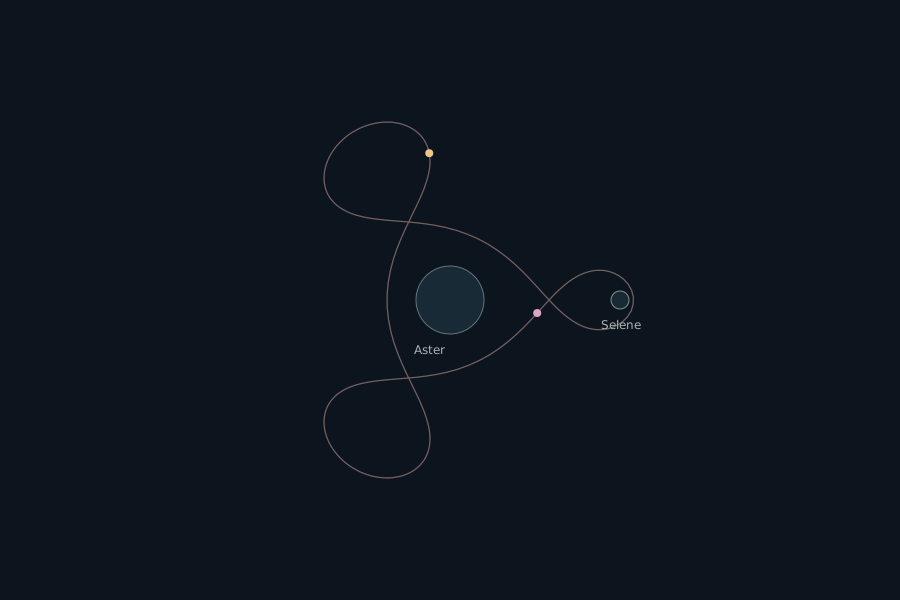
Have you ever stared at the animations on Wikipedia's Hohmann transfer orbit article and wished for more? Or have you tried out NASA’s Eyes but found the real scale of space a bit hard to navigate? Me too.
Orbital Logistics is a collection of exhibits demonstrating various orbits and maneuvers in small-scale fictional settings: a model train set but for spaceships. You can follow a ship, change your point of view, scrub through time, slow down for a burn, or just leave the traffic running as a sort of screensaver. Explore the exhibits, or read on for some brief explanations of the viewer's features.
Simultaneous views
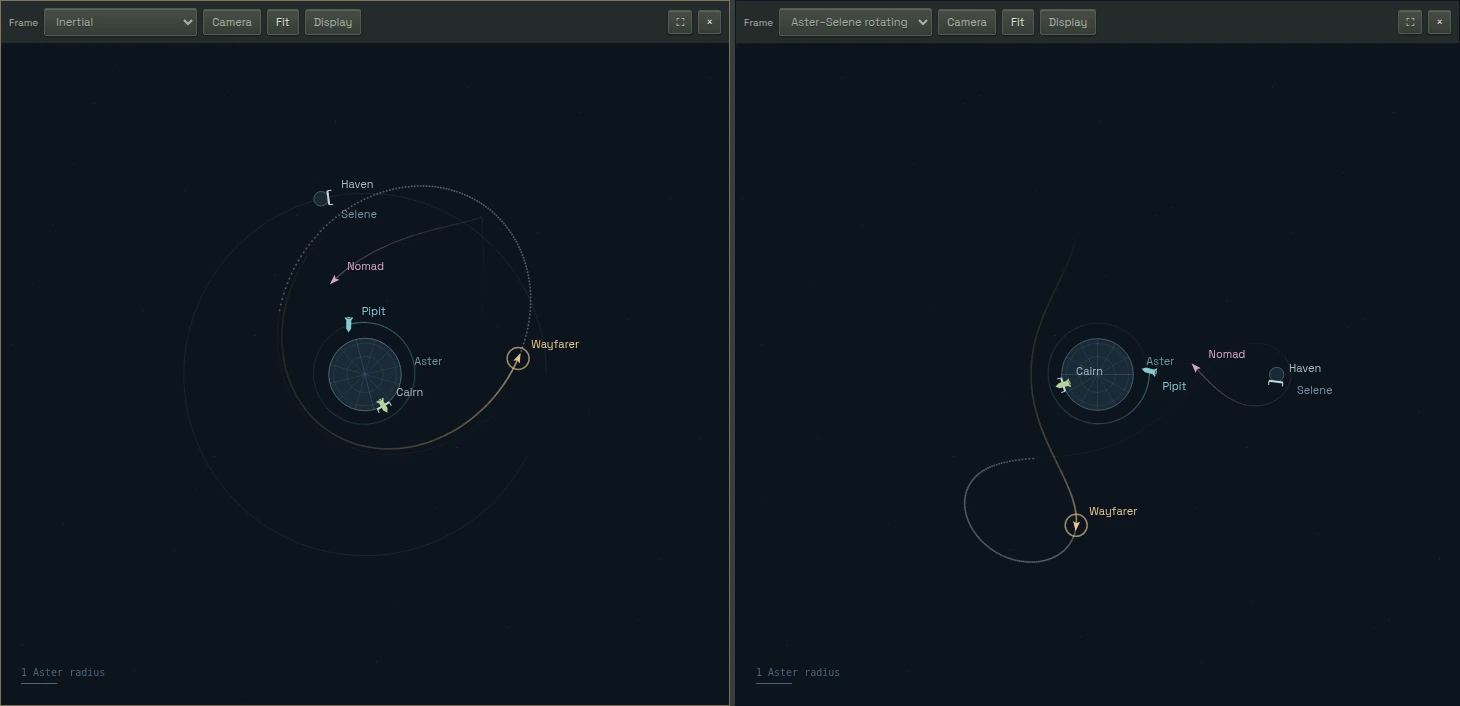
Some really complicated orbits become easier to understand when you change the view (a.k.a. the "reference frame"). Orbital Logistics lets you see multiple frames at the same time.
The rubber sheet analogy
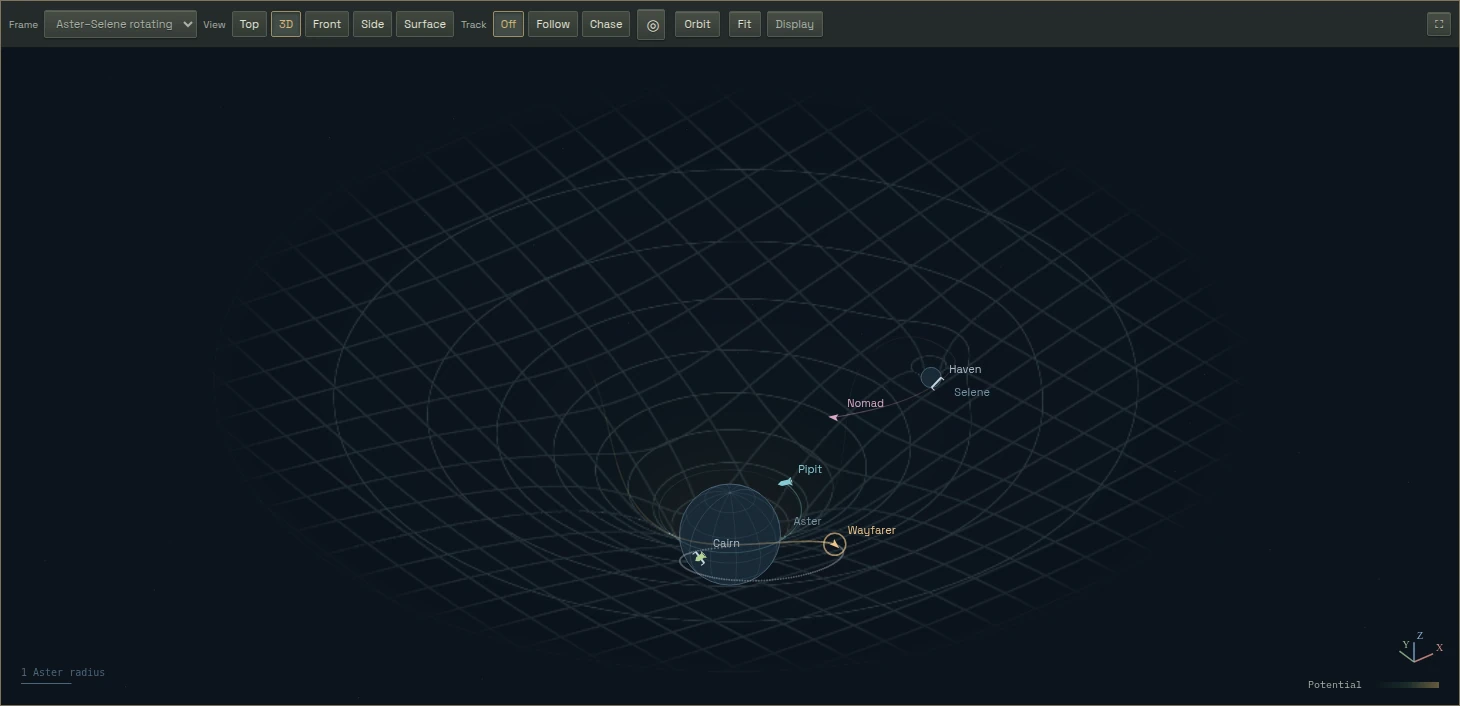
Yes, we have the ol' classic of gravity analogies, the rubber sheet with planets indented into it and spaceships circling the well. While it's a somewhat dubious/leaky analogy for some parts of orbital mechanics, it definitely looks cool. For sets where everything happens in a single plane, you can turn it on.
A few of the available sets
- Cycler fleet: carriers loop past two worlds while smaller shuttles ferry freight between them and the ground. Inspired by the idea of a lunar cycler.
- Full service: a busier neighborhood of staged expeditions, lunar landers, ground ports and relay stations.
- Continuous survey: an observatory traces a three-dimensional Lissajous orbit near L2. Long trails gradually reveal the pattern.
Hypothetically Asked Questions
Why?
Space is cool! This project actually started as a video game idea to make some sort of logistics/space trucking simulator at the scale of Outer Wilds but with, like, more "real" orbital maneuvers. However, it turns out even at a small scale, low delta-V ballistic orbits are still slow; gravity doesn't really scale the way I thought it would.
My second idea was to turn this into some sort of automation puzzle game, like Opus Magnum but between planets, where you solve a puzzle and also get a cool looping GIF out of it. I also played Children of a Dead Earth and liked its orbital maneuver editor, and thought that could be a neat interface. However, for simple circular orbits in the same plane, making optimal maneuvers usually boils down to Hohmann transfers (at least for the "low delta-V" meaning of optimal), so it didn't quite have the same tradeoffs that make Opus Magnum interesting. There's maybe still a way to make this work, but I also realized I still got most of the enjoyment just watching the maneuvers work, even if I didn't design them.
So here we are. Just the viewer, minus any gameplay. I hope you also still find it compelling.
How much of the physics is simulated?
A fair bit. Ships follow three-dimensional Newtonian trajectories under the gravity of prescribed moving bodies. Powered flights can model finite thrust, steering, acceleration limits and fuel use. Some exhibits also include staging, stationkeeping and (simplified) atmospheric drag and lift.
However, the large bodies follow specified paths and ships do not pull on one another. Docking uses bounded position and velocity capture rather than hull contact; ships are essentially just point particles.
Also, real space is kind of big. These sets also use fictional systems to keep things at an interesting scale, again sort of like train sets. If you want real space and real spaceships, I recommend NASA’s Eyes, which is also a web app.
Can you edit or make your own sets?
Not in the viewer, at least not yet. The viewer code is nominally open source on GitHub. However, it was entirely implemented (appropriately, I suppose) by GPT-6 Astra and GPT-6.1 Sol. Unfortunately there are no carefully human-crafted algorithms or architecture or comments to study, sorry. If you'd like to vibecode up your own sets though, I'll take submissions.
The prompt source code might be more interesting to read: my messages from building this, with condensed summaries of the implementation work and replies.
Does it work on mobile?
It might, but the interface will be awkward and cramped. Sorry. I may get around to making a friendlier mobile UI at some point.